
Moulding Rubber Parts
What is rubber moulding?
Rubber moulding is a manufacturing process that takes raw rubber material and forms it into a product of the desired three-dimensional geometry. Because rubber is highly elastic, it is an extremely versatile material for industrial applications – capable of absorbing vibration, creating reliable seals, protecting components and providing structural support across a huge range of industries.
Typical moulded rubber products include:
Vibration and noise reduction:
- Rubber bumpers
- Rubber bushings
- Rubber pads
- Rubber isolators
Sealing and leak prevention:
- Rubber diaphragms
- Rubber O-rings
- Rubber seals
Component protection:
- Rubber grommets
- Rubber plugs
Structural support:
- Rubber mounts
Handling and gripping:
- Rubber suction cups
Load distribution:
There is also blow and vacuum moulding, though these processes are used almost exclusively for plastics rather than rubber.
Choosing the Right Moulding Process
Choosing the right rubber moulding process can have a significant impact on cost, lead time, part quality and tooling investment. Yet for many engineers and procurement managers, the differences between compression moulding, transfer moulding and injection moulding of rubber aren't always clear –and the wrong choice early in a project can be expensive to correct.
This guide is structured around the questions buyers actually ask: how do the three processes work, when is each one right, and what are the trade-offs?
Following Walker Rubber’s acquisition of Clingbrook, we now offer substantially expanded capacity for all three moulding processes alongside our in-house tooling and a full range of compounds. That means we can help you find the right process for your part, not just the one we happen to offer.
What are the different types of rubber moulding?
Three commonly used types of moulding are:
- Compression moulding
- Injection moulding
- Transfer moulding
There is also blow and vacuum moulding, however, this is conducted most of the time on plastics.
Multiple rubber moulding processes have been devised over the years as a result of unique manufacturing situations. These processes have different requirements and limitations.
What is compression moulding?
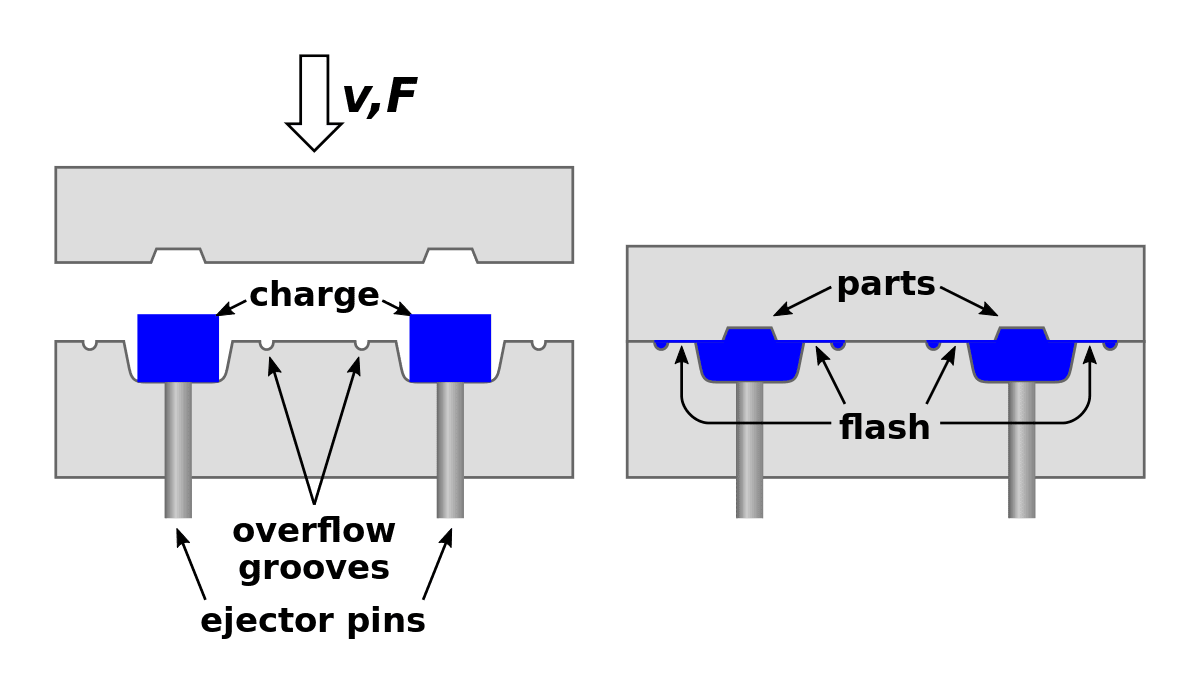
Compression moulding is the oldest and most straightforward of the three methods. A pre-measured quantity of unvulcanised rubber is placed directly into an open mould cavity. The mould is then closed under pressure and heated, causing the rubber to expand, fill the cavity and vulcanise (cure) into its final shape.
There's no injection system, no runner and no sprue – just rubber, heat and pressure. This simplicity makes compression moulding of rubber well suited to large, simple parts where keeping tooling costs low is the priority.
When compression moulding of rubber is the right choice:
- Parts with large cross-sectional areas or thick sections, where other processes struggle to fill the cavity evenly
- Low to medium production volumes, where lower tooling costs make more economic sense
- Compounds that are difficult to process through injection systems, particularly highly filled or very stiff materials
- Simpler part geometries where tight tolerances aren't the primary requirement
What are the advantages of compression moulding?
The benefits of using compression moulding are:
- Less wastage
- Less technical and less drain on money and resources than injection moulding.
- Recommended for parts with large cross-sectional areas
- Easier to process highly durable and robust rubber. Due to its increased capacity.
The disadvantages of compression moulding are:
- Difficult to retain a level of consistency with finished parts
- Takes longer than other processes
What is injection moulding?
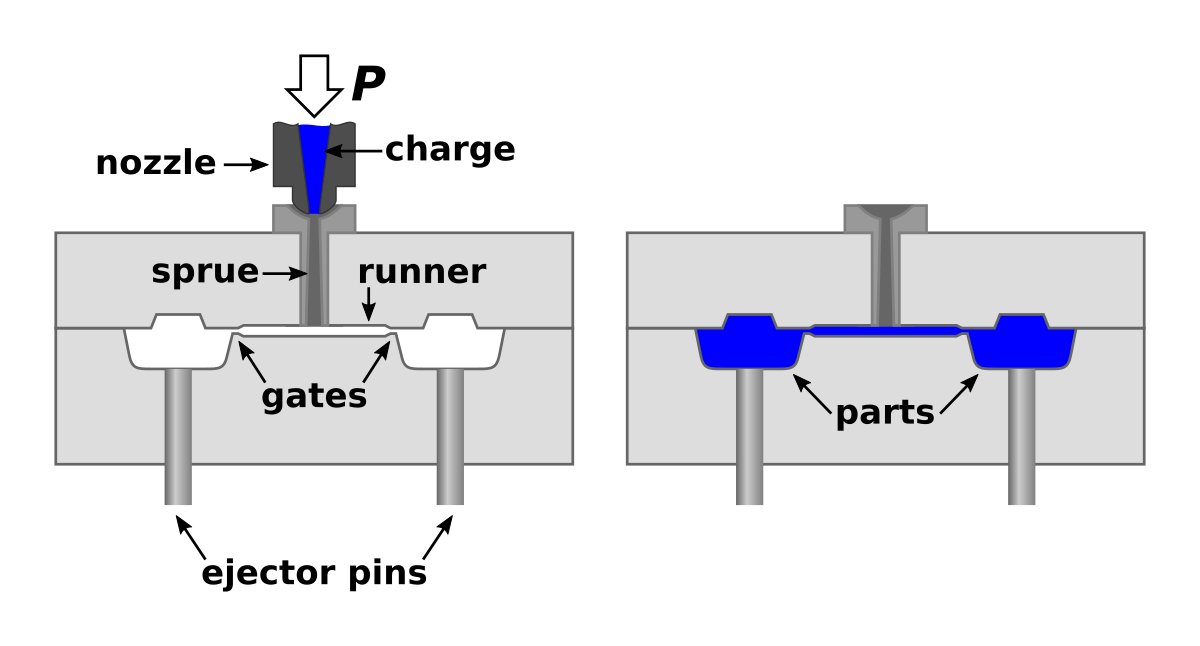
Rubber injection moulding offers the highest level of precision and is the process of choice for high-volume production. Raw rubber is heated until it flows easily, then injected under pressure through a nozzle and barrel assembly into a closed, temperature-controlled mould.
The preheating shortens cure times significantly and allows for higher curing temperatures. The high clamp force minimises flash. Originally developed for plastics, injection moulding of rubber has been standard practice since the 1960s and is now the go-to process for tight-tolerance, high-volume parts.
When rubber injection moulding is the right choice:
- High-precision components requiring tight dimensional tolerances – particularly in automotive, aerospace, and medical applications
- High-volume production runs, where faster cycle times and minimal post-moulding work justify the higher tooling investment
- Parts where consistency is critical and part-to-part variation must be kept to a minimum
- Complex geometries where full, reliable cavity fill is essential
What are the advantages of injection moulding?
There are a range of benefits that come from rubber injection moulding, such as:
- Waste minimisation
- Quick rollout times
- Speedy production
- High-dimensional tolerances
However, as with any manufacturing process, there are some disadvantages:
- Setup can be expensive
- Tooling limitation and design capabilities
- The need for expensive tooling and machinery
What is transfer moulding?
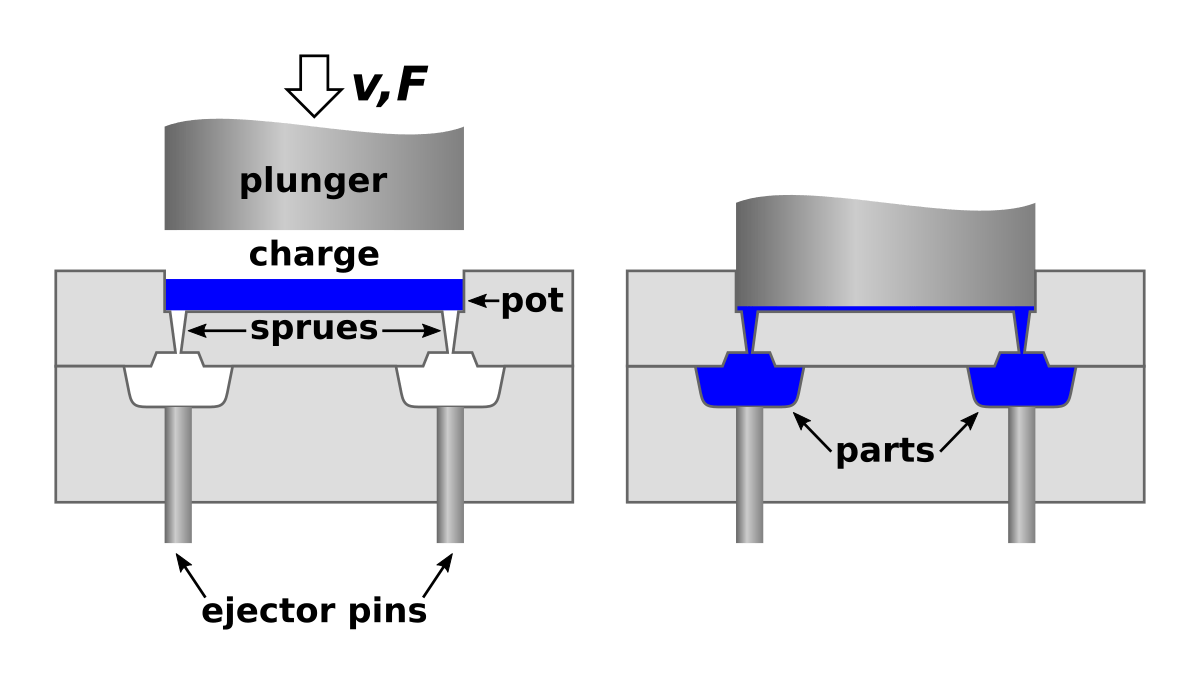
Transfer moulding sits between compression and injection moulding in both complexity and capability. A pre-formed billet of rubber is placed into a pot above the closed mould. A plunger then forces the material through small channels (sprues) into the mould cavities below.
Because the mould is already closed before material enters it, transfer moulding gives better dimensional control than compression moulding of rubber – with less flash and more repeatable results.
When transfer moulding is the right choice:
- Parts with more intricate geometries or tighter tolerances than compression moulding can reliably achieve
- Insert moulding applications, where metal or other inserts need to be encapsulated (the closed mould protects inserts from displacement during loading)
- Medium production volumes, where the process delivers a good balance of quality and tooling cost
- Parts where flash control matters, such as seals, bellows or components that mate to other surfaces
What are the advantages of injection moulding?
The advantages of transfer moulding are:
- Greater accuracy than compression moulding
- Short manufacturing process
The disadvantages of transfer moulding are:
- Potential rise in material wastage
- Maintenance and repairs can be time-consuming
- Designing detailed and technical parts can be costly
What materials are used for rubber moulding?
All three rubber moulding processes can be used with a wide range of compounds. The right material depends on the operating environment — temperature, chemical exposure, dynamic load, and any regulatory requirements.
Walker Rubber works across the full range of technical compounds:
- Natural Rubber (NR) — high strength and resilience; widely used for anti-vibration mounts and components requiring high dynamic performance
- Nitrile / Buna-N (NBR) — outstanding oil and fuel resistance; the standard choice for hydraulic and fuel system components
- EPDM — excellent weather, ozone and UV resistance; widely used in automotive sealing and outdoor industrial applications
- Silicone — broad temperature range; food-grade options available for medical, food processing and high-temperature applications
- Neoprene (CR) — good all-round resistance to weather, oil and flame; widely used in industrial and marine applications
- Styrene Butadiene (SBR) — good abrasion resistance; a cost-effective general-purpose alternative to natural rubber
- Fluorocarbon / Viton (FKM) — exceptional chemical and heat resistance; specified for aerospace, chemical processing and demanding industrial environments
- Butyl / Isobutylene Isoprene (IIR) — excellent gas impermeability and vibration damping; used in pharmaceutical stoppers and damping components
If you're unsure which compound is right for your application, our technical team can advise based on the environment, chemical exposure, temperature range and mechanical requirements.
Process Comparison: Which is Right for Your Part?
When choosing between the three rubber moulding processes, four variables tend to drive the decision:
Part complexity
For simple, large-section parts, compression moulding of rubber is often the most cost-effective route. As complexity increases – particularly for insert moulding or intricate geometries – transfer moulding becomes more suitable. For the highest precision requirements, injection moulding of rubber is the natural choice.
Volume
Compression moulding has the lowest tooling cost and makes sense at lower volumes. Injection moulding of rubber has the highest tooling cost but the lowest per-part cost at volume. Transfer sits in the middle on both counts.
Tooling cost and lead time
Walker Rubber's in-house tooling capability changes this calculation. Rather than outsourcing tooling to a third party (adding cost, lead time and a communication layer) we design and manufacture tooling on site. This typically reduces both cost and the time from design approval to first samples.
Flash and finishing requirements
If minimal flash is important, for instance, on sealing faces or cosmetically visible surfaces, injection or transfer moulding will deliver better results than compression. The additional finishing time associated with compression flash can erode its cost advantage for certain parts.
How to Enquire
To help us provide an accurate quote quickly, the following information is useful:
- A 2D drawing or 3D CAD file (PDF, DXF, STEP or IGES)
- If no drawing exists, a physical sample or a description of the part's dimensions and function
- Your target compound, or the operating conditions if you're unsure
- Required volumes and any tolerance or certification requirements
If you're looking for a supplier for custom moulded rubber parts, visit our rubber moulding service page for full details on our capabilities and lead times, or contact us today.