
A failed container door seal rarely announces itself. More often, you find out the hard way – a pallet of moisture-damaged goods, a mould claim, a refrigerated cargo dispute, or a compliance audit that flags inadequate weatherproofing. By then, the cost of the wrong seal has already been paid.
You can think of this guide a bit like a premortem – working backwards from those failures to help fleet engineers, logistics procurement managers, and container leasing operators specify the right rubber door seal before it becomes an expensive lesson.
Why Container Door Seals Fail
Container door seals operate in some of the harshest conditions any rubber product will face: UV radiation, saltwater spray, wide temperature swings, constant compression and release through hundreds of open-and-close cycles, and extended outdoor storage on exposed yards and port facilities.
The three most common causes of premature failure are:
UV and ozone degradation. Continuous outdoor exposure breaks down the polymer chains in many rubber compounds, causing surface cracking that progressively worsens until the seal no longer maintains a reliable contact. A seal that looks serviceable may already have lost a significant portion of its sealing performance –cracked rubber compresses unevenly and leaves gaps that admit moisture, pests, and contaminated air.
Compression set. Every time a container door closes, the seal compresses. Every time it opens, the seal must recover. Over time, a rubber compound with poor compression set resistance will fail to spring back – it takes a permanent 'squash' – and the contact force against the door frame drops below what is needed for effective sealing. This is an insidious failure mode because the seal remains physically intact but is no longer doing its job.
Wrong compound selection. This is the root cause that explains many of the above failures. A seal specified for an indoor industrial application – or simply selected on price – will not have the compound properties required for marine and outdoor container use. Specifying the wrong rubber for the environment is the single most avoidable cause of early seal failure.
EPDM vs Neoprene: Choosing the Right Compound
For container door seals, the two compounds most commonly considered are EPDM and Neoprene (CR). Understanding the difference matters.
EPDM (Ethylene Propylene Diene Monomer) is the preferred choice for the majority of container door seal applications. It offers outstanding resistance to UV, ozone, and weathering, properties that come directly from its molecular structure, which contains no double bonds in the main polymer chain and is therefore far less susceptible to ozone attack. EPDM also delivers excellent compression set resistance over wide temperature ranges (typically rated from around -40°C to +120°C), making it well suited to containers that move between climates or sit in exposed port environments for extended periods. Where the primary challenge is weathering and long-term sealing performance, EPDM is almost always the right answer.
Neoprene (Polychloroprene) brings a different set of strengths. It performs well where oil and fuel resistance is required, offers good flame retardancy, and has solid mechanical toughness. For container applications specifically, Neoprene may be specified where the seal is exposed to oily residues from freight or where regulatory requirements around flame performance apply. However, Neoprene's weathering and UV resistance is notably inferior to EPDM, and it is generally the secondary choice for standard outdoor container door sealing unless there is a specific operational reason to use it.
The short version: for most shipping container door seals facing the marine and outdoor environment, EPDM is the correct starting point.
Extrusion Profiles and Corner Solutions
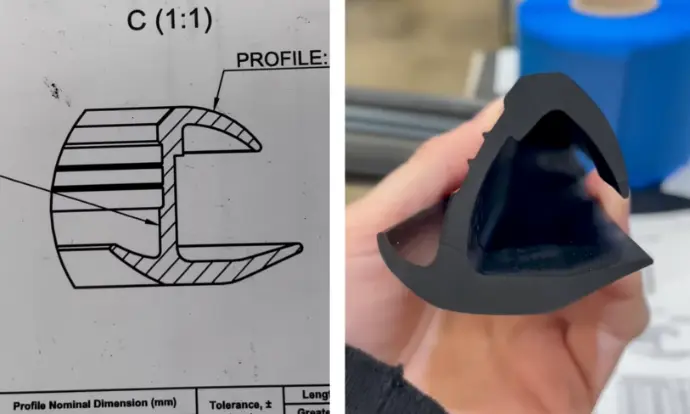
Container door seals are almost universally extruded rubber profiles; continuous lengths of rubber formed into a cross-sectional shape designed to compress against the door frame and maintain contact under load. The profile geometry matters considerably to performance.
Common profiles used in container door sealing include:
J-seals
The profile most widely used on steel shipping container doors specifically. A J-seal has a cross-section shaped like the letter J: a long back leg that fixes to the door frame, with a curved sealing lip that folds over to make contact with the opposing surface. This geometry makes J-seals particularly easy to install — the profile simply presses into place along the door edge and the curved lip provides a consistent sealing contact across a range of door gap tolerances. J-seals are a go-to choice for standard 20ft and 40ft ISO containers and are manufactured in a range of sizes to suit different door frame dimensions.
Bulb seals
A hollow or solid rounded bulb section that deforms on compression, providing a progressive and forgiving contact. Widely used on standard shipping container doors where the compression force is moderate and the contact surface may not be perfectly flat.
P-seals and D-seals
Named for their cross-sectional shape. P-seals incorporate a mounting foot with a sealing bulb; D-seals offer a solid semi-circular section. Both are common in container and hatch applications where a defined compression height is needed.
The profile must be matched to the available compression gap (the distance the door can close against the seal before mechanical stop), the surface condition of the frame, and the force the door closure mechanism will apply. Specifying without these dimensions is one of the most common errors in container seal replacement.
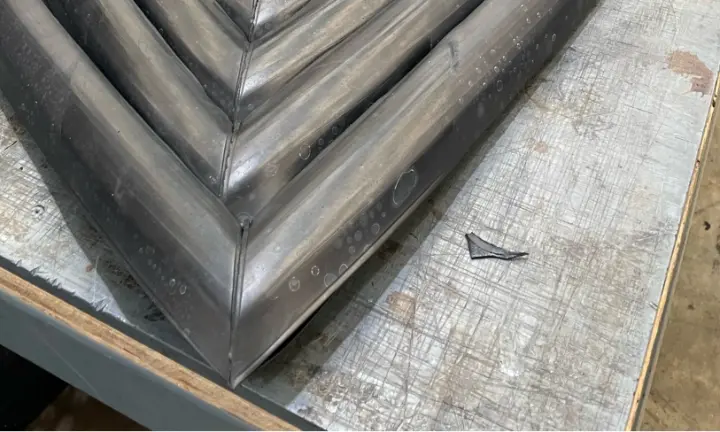
Corner solutions are a critical detail that is frequently overlooked. A straight extruded seal run around a rectangular door frame will leave four corners where the seal must either be mitred and joined (AKA splicing) or fitted to a moulded corner piece. Poorly executed corners are the most common leak point in any door seal installation. Spliced joints bonded with vulcanising adhesive can perform well when done correctly, but moulded corners – produced by injecting rubber into a mould that incorporates the geometry of the corner – provide a seamless, factory-finished solution with no bond line to fail.
How to Specify a Container Door Seal
Effective specification requires several key pieces of information. Rushing this stage is what leads to seals that fit dimensionally but fail in service.
Profile dimensions. What is the cross-section of the existing seal, or the channel it will sit in? Width, height, and wall thickness (for hollow sections) all need to be confirmed. If replacing an existing seal, the original profile drawing or a physical sample is the best starting point.
Compression requirements. How much will the seal compress when the door closes? This defines the working deflection range the profile must accommodate. Too little compression and you will not achieve a seal; too much and you will either damage the seal or prevent the door from closing fully.
Material compound. As covered above, EPDM for weathering and UV resistance in most container applications; Neoprene where specific resistance to oils or flame requirements applies. The hardness of the compound (expressed as Shore A) also matters – softer grades (40–55 Shore A) provide lower closure force and more forgiving contact; harder grades (60–70 Shore A) offer greater durability where abrasion is a concern.
Length and corner treatment. What lengths are required? Are corners mitred, joined, or moulded? For high-volume container fleet operators, custom moulded corner sets matched to the door geometry provide the most reliable result.
Certifications and standards. Some container operators and leasing companies require seals that meet specific standards, customer-specific quality specifications, or material certification for food-grade cargo use. These requirements need to be identified at specification stage, not after an order is placed.
Walker Rubber's Capability for Container Door Seals
Walker Rubber manufactures custom rubber extrusions from its facility in Norwich, with in-house tooling that allows profiles to be produced to customer drawings without the delays or minimum order quantities that typically apply when tooling is held with a third-party supplier.
For container door seal applications specifically, this means:
- Custom EPDM and Neoprene extrusion profiles produced to your section drawing or reverse-engineered from a physical sample
- Spliced corners to complete the seal set, addressing the detail that most supply-only relationships leave to the customer to solve
- No minimum order quantities; useful for maintenance fleets where replacement seals are needed for specific container types in limited numbers
- Same-day quoting on most enquiries, with make-to-order lead times from 48 hours for standard extrusions
The combination of technical materials knowledge, extrusion capability, and the ability to produce spliced corners in-house makes Walker Rubber well-positioned for both direct container operators and the seal manufacturers who supply into the marine and logistics sector.
Specifying Correctly: A Summary
If you are responsible for container door seals, whether specifying replacements for an owned fleet, sourcing for a container leasing operation, or advising on maintenance programmes, the decisions that matter most happen before an order is placed:
- Choose EPDM as your default compound for outdoor, marine, and weathering applications.
- Specify compression set resistance as a key material requirement alongside hardness.
- Confirm the profile geometry against the door frame geometry before tooling.
- Address corners explicitly and do not leave them to chance.
- Work with a supplier who can provide material certification and respond quickly when a seal specification needs to change.
A rubber door seal is a small component in the context of a shipping container. The cost of getting it wrong is disproportionate to its price.
Walker Rubber manufactures precision rubber extrusions from Norwich, UK. Custom container door seal profiles and spliced assemblies are available with no minimum order quantity and lead times from 48 hours.